Every shift, from roster to claim, in one spot.
CareSpot is the operations system for Australian care providers: rostering, location-verified attendance, timesheet approvals, claiming, invoicing, pay runs, and the policies and registers an audit asks for — one record of every visit, from the phone at the door to the money in the bank. NDIS in full today; aged care under Support at Home is in pilot.
30-day trial · No card needed to start · Hosted in Australia
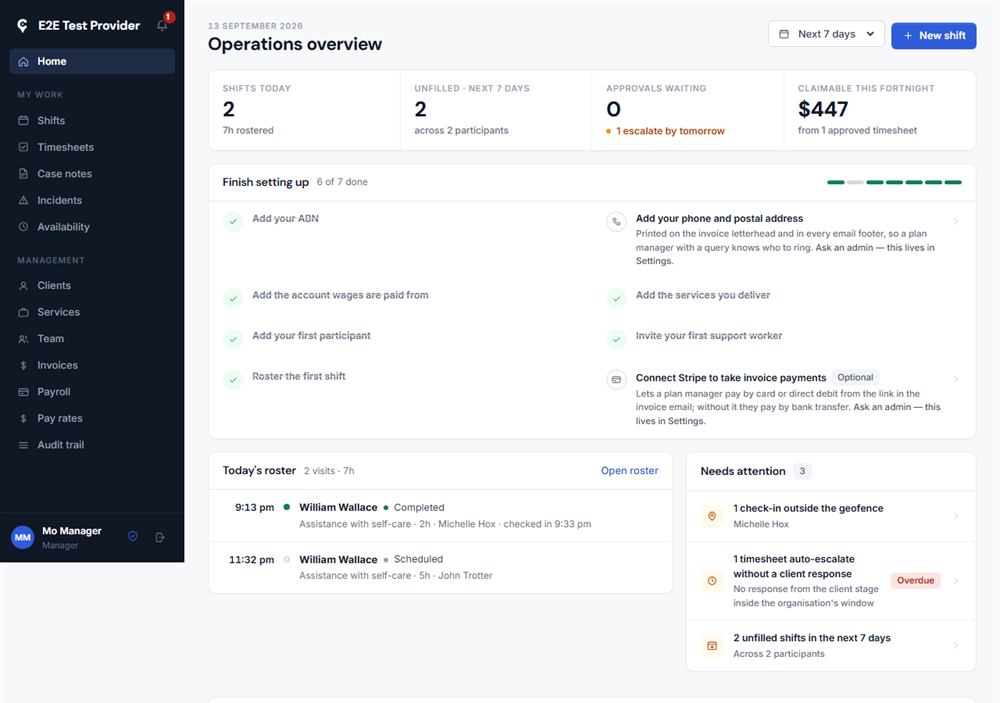
From a rostered shift to money in the bank, without re-keying it five times.
The same visit carries through every step. What the worker checked in to is what the representative approves, what the manager signs off, what the NDIA is claimed for and what the worker is paid for.
Roster
Shifts are checked against availability, leave and expiring documents before they're published. Open shifts go to the board for workers to claim.
Check in
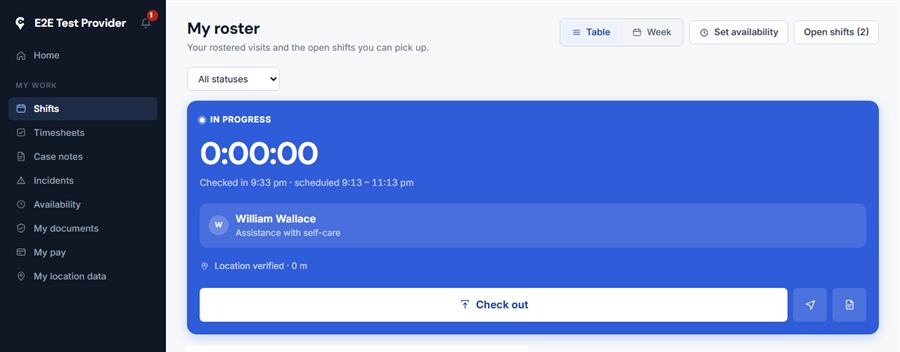
The worker checks in at the door from their phone. Distance to the participant's address is verified against the geofence and recorded on the shift.
Approve
Participant or representative first, then the manager. Representatives approve from an email — no account needed. Silence escalates on a timer you set.
Claim & invoice
Approved timesheets become the NDIA bulk-payment CSV and tax invoices. Price limits are enforced and duplicate claims are blocked before they leave.
Pay
Pay runs come from the same approved hours: an ABA file for your bank, or straight into Xero Payroll. Each worker sees their pay advice under My pay.
Nothing to install. One button when it matters.
Workers open CareSpot on their phone, see their week, claim open shifts near them, and check in and out at the door. Case notes are written against the visit. Pay advices and their own location records are theirs to see, any time.
- Push notifications for new open shifts and approvals
- Renew their own compliance documents, with every previous version kept
- Location is recorded at check-in and check-out only, unless the organisation has lawfully turned on continuous tracking
The parts of the job that have hard rules, handled.
Rostering & availability
Recurring availability, one-off unavailability and a leave workflow. Double-bookings, leave clashes and expired compliance documents are caught when the shift is saved — with an explicit override when a manager decides otherwise.
Location-verified attendance
Check-in and check-out carry the distance from the participant's geocoded address. Inside the geofence it's verified; outside, it's flagged for the manager to look at — not silently accepted, not silently rejected.
Two-stage approvals
The participant or representative stage can be required, optional or skipped per organisation. Unanswered requests escalate automatically, a manager always has the final gate, and the full history is on the timesheet record.
NDIS claiming & invoicing
Support items with evening, weekend and public-holiday rates, capped at the price guide. The bulk-payment CSV in the NDIA's exact column order. Tax invoices with a Pay link — card or BECS direct debit — that settles into your own Stripe account, never ours.
Incidents, on the Commission's clock
Six reportable categories. The 24-hour and five-business-day deadlines start when the incident is logged and alert before they run out. Representatives are notified automatically and the record is immutable.
Payroll & pay runs
Pay rates by classification and penalty window. A pay run from approved hours produces an ABA file for your bank or posts to Xero Payroll, where the bank, tax and super details already live. Pay advices as PDFs.
Built for an audit, not just a demo.
You are handling health information about vulnerable people, money that belongs to the NDIA and to workers, and the movements of your staff. The defaults reflect that.
Hosted in Australia
Database, documents and backups stay in an Australian region. The application refuses to start if configured otherwise.
An audit trail you can't edit
Every change is appended with who, when and a correlation ID. Searchable, exportable, and every printed record is logged as it's exported.
Two-factor authentication
Authenticator-app codes with backup codes, and an organisation setting that makes it mandatory for admins and managers.
Location tracking, done lawfully
Continuous tracking is off by default and cannot be switched on until every worker has had 14 days' written notice. Workers can see their own location records.
Nightly encrypted backups
With a rehearsed restore and a health check that turns red after a missed night — so a backup that quietly stopped is noticed the next morning.
Role boundaries that hold
Admin, manager, worker and representative. Workers see only their own notes, pay and location data; representatives see only their participant.
A base fee, plus the workers who actually worked.
An active worker is a support worker who used CareSpot during the month. Someone who joined on the 3rd and left on the 20th counts once. Managers, admins and representatives are never counted, and you're never charged for a worker who didn't work.
Invoiced monthly, paid by bank transfer. No card required, no lock-in, no setup fee.
- Every feature, every role — no tiers
- Nothing sold as an add-on
- Unlimited participants and representatives
- 30-day trial, then month to month
- Setup help during early access
Prices in AUD, excluding GST.
The six we are asked first.
Fifty-three more are answered plainly on the FAQ, from what a worker can see to what happens to your data if you leave.
Read the FAQWho is CareSpot for?
Registered and unregistered NDIS providers, and community care organisations that roster support workers to visit participants. Aged care providers delivering Support at Home are in pilot now. It is built for the organisation, not for individual participants looking for services.
Do we have to be a registered NDIS provider?
No. The difference is who you invoice: agency-managed participants are claimed through the NDIA bulk payment request, which only registered providers lodge; plan-managed and self-managed participants are invoiced by email, which anyone can do. CareSpot supports both from the same visits.
Can we bring our participants and workers across?
Yes, yourself, from the spreadsheet you already have. The import reads your own column headings, shows you every row and what would happen to it, and only then writes anything. A guardian's name and email on a row creates their family-portal login.
Does CareSpot lodge our claims with the NDIA?
Not yet. It produces the bulk payment request CSV in the NDIA's exact format from manager-approved timesheets, and you upload it through the provider portal. Each line carries a reproducible claim reference, so the same visit cannot be claimed twice.
What can we show an auditor?
Your policies with who signed which version, a self-assessment against the Practice Standards with its improvement register, the incident, complaint and restrictive-practice registers, care plans with their history, and an evidence pack built for the sample they ask for. The auditor can have their own read-only access that expires on its own.
Where is our data kept?
In Australia. The database, uploaded documents and nightly encrypted backups all stay in an Australian region, and the application refuses to start if it is configured otherwise. Participants' NDIS numbers, dates of birth and health notes are encrypted in the database itself.
See your own roster in it before you decide.
We're onboarding a small number of providers ahead of general release, with hands-on setup. Bring a fortnight of real shifts and we'll walk it through to a claim together.